How local delivery networks can outperform national carriers in last-mile logistics
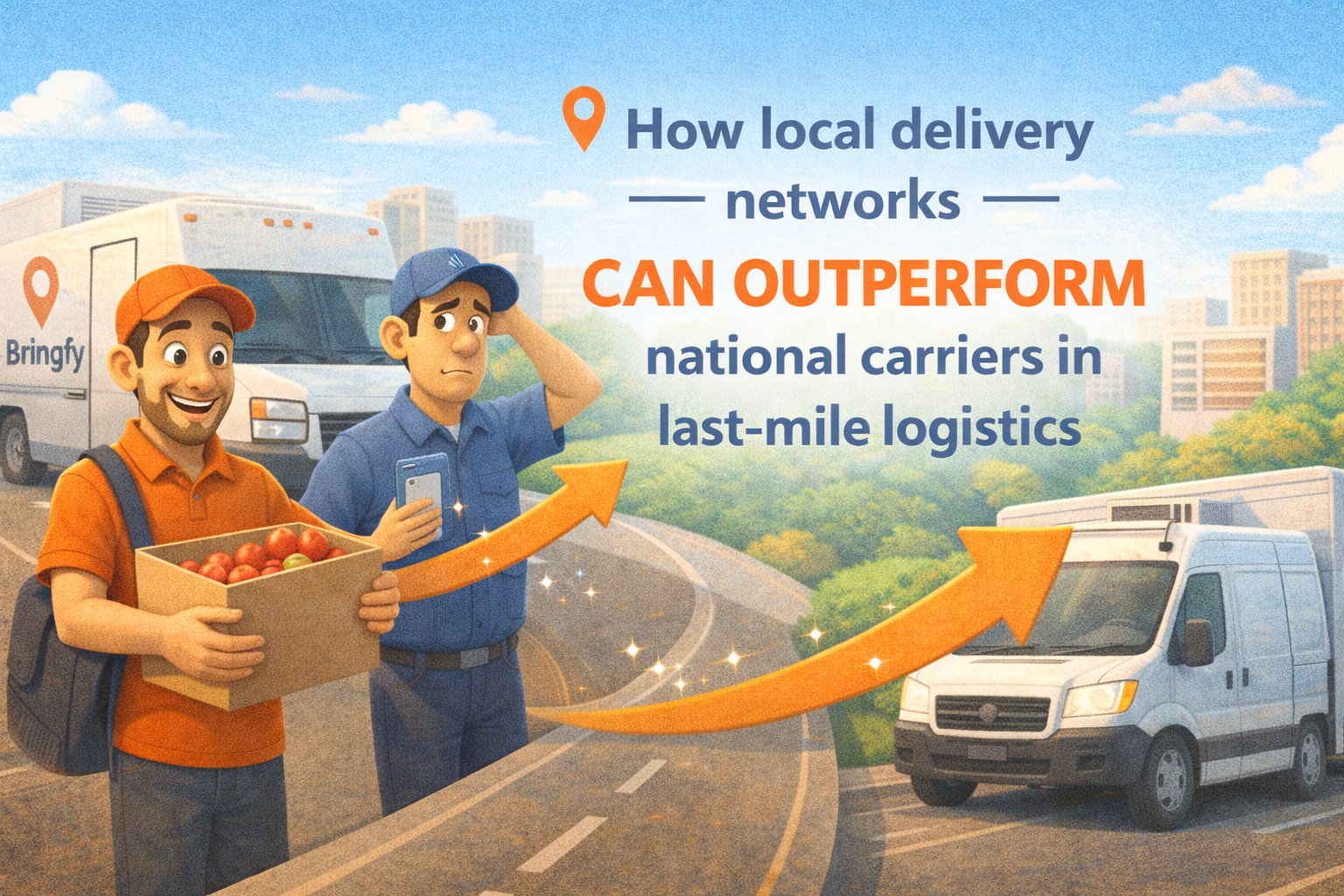
In today’s economy, delivery speed is no longer a competitive advantage. It is a baseline expectation. Customers want fast shipping, accurate tracking, and reliable arrival windows. For many small and mid-sized businesses, the default reaction is to rely on large national carriers. They seem safe, scalable, and established. But what if the real competitive advantage is local?
The real challenge: last-mile logistics
The last mile is the most expensive and complex part of the supply chain. It represents the final stretch between a distribution point and the customer’s doorstep. Traffic, failed deliveries, inefficient routing, and low drop density all increase operational costs.
National carriers are optimized for volume and geographic coverage. Their systems are designed to move massive quantities of parcels across provinces and countries. That scale is powerful, but it does not always translate into flexibility.
For a local restaurant, boutique retailer, food supplier, or specialty store, agility matters more than global reach.
Scale vs agility
Large carriers operate with standardized processes. They follow predefined routes, central hubs, and fixed time windows. This structure works well at national scale but can become rigid at the neighborhood level.
Local delivery networks operate differently.
They rely on hyperlocal routing, real-time dispatch optimization, and closer proximity to both businesses and customers. That means:
-
Faster same-day and next-day delivery options
-
Reduced delivery windows
-
Greater flexibility for urgent or high-priority orders
-
Better understanding of local traffic patterns and neighborhoods
In dense urban areas, a well-designed local network can often outperform national systems in both speed and cost efficiency.
Technology as the equalizer
The real differentiator is not just proximity. It is technology.
Modern local delivery platforms combine logistics with smart software. Real-time tracking, automated dispatching, route optimization algorithms, and data analytics allow smaller networks to operate with enterprise-level intelligence.
Businesses gain:
-
Full visibility into delivery status
-
Data insights on delivery performance
-
Reduced failed deliveries
-
Better customer communication
When customers can track their orders in real time and receive accurate updates, trust increases. And trust drives repeat business.
Customer experience is local
Delivery is not just a transaction. It is part of the brand experience.
A local courier network represents your business in the community. Drivers understand the neighborhoods they serve. They build familiarity with stores and repeat customers. This human factor is often overlooked but incredibly powerful.
Customers remember when deliveries are smooth. They also remember when they are not.
Localized logistics reduces friction and strengthens loyalty.
Sustainability and smarter routes
There is also an environmental dimension.
Shorter routes, optimized dispatching, and smaller service areas reduce fuel consumption and emissions. Many local networks can integrate electric vehicles or low-emission fleets more easily than national carriers operating across long distances.
Sustainability is no longer optional. Customers and businesses increasingly value responsible logistics solutions.
The competitive advantage of going local
Local logistics is not about replacing national carriers entirely. It is about building a smarter distribution strategy.
For many small and mid-sized businesses, combining local delivery networks with technology-driven platforms creates a leaner, more responsive, and more customer-centric solution.
In the new economy, speed is expected. Transparency is required. Flexibility is critical.
Local delivery networks, powered by smart technology, are uniquely positioned to deliver all three.
If you are rethinking your last-mile strategy, it may be time to look closer to home.